
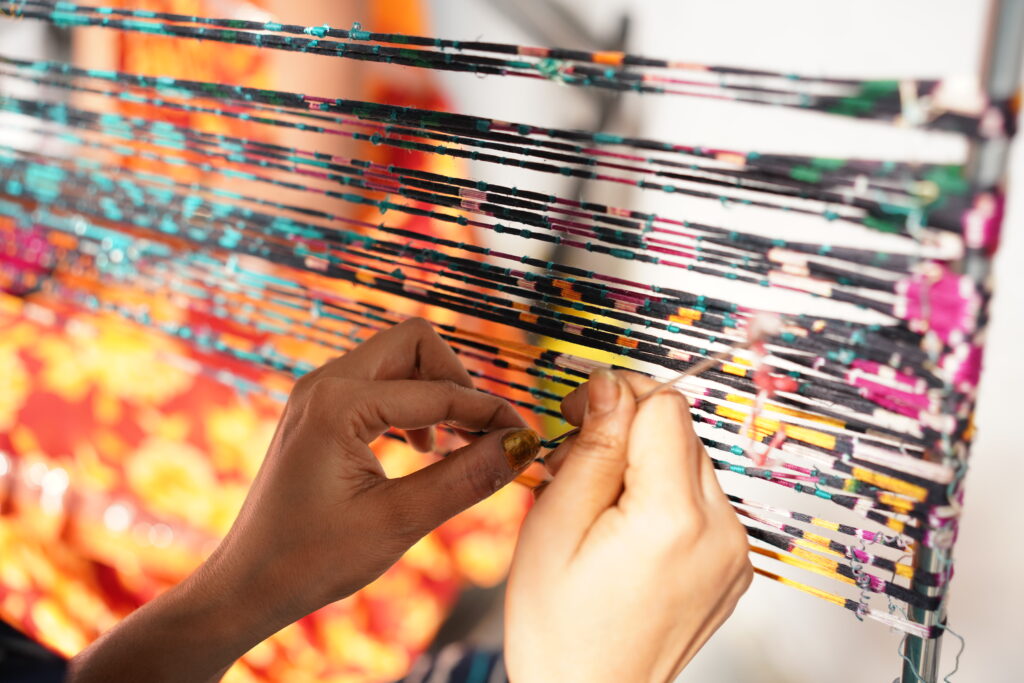
The warp threads of several repeats of a pattern are arrange on the loom in a specific order once the dyeing of the warps and wefts is finished, revealing the pattern. For use in the weaving process, the weft threads are coiled onto bobbins and retained in the bamboo shuttle.
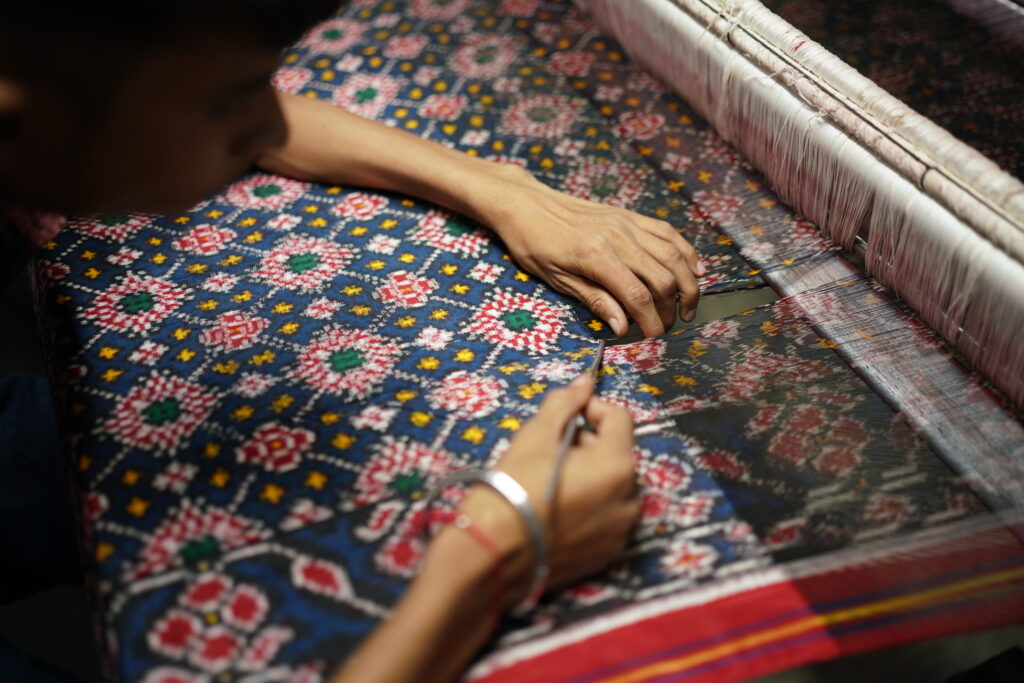
A crude hand-operated harness loom made of rosewood and bamboo strips is used to weave the patola. The loom lies at a slant, with the left side being lower than the right side. The warp shades let the bamboo shuttle travel back and forth. During weaving, each weft thread is carefully inspected and matched with every component of the warp design pattern.

After weaving an 8′′ to 10′′ square of fabric each time, the tension of the warp threads is released with the use of a needle. With merely the placement of warp and weft that are the same hue, patola weaving can achieve the ideal pattern and harmony.
It takes a lot of time, effort, and great levels of ability and dexterity to complete the process.
For one sari measuring 6 yards long by 48 inches wide, tie-dye designs on warp and weft threads must be prepared in three to four months. Together, two Salvis (weavers) can only weave 8 to 9 inches each day.
A sari is woven in 40 to 50 days. Accordingly, 4 to 5 people need between 5 and 6 months to finish a sari, depending on how intricate the design is.